
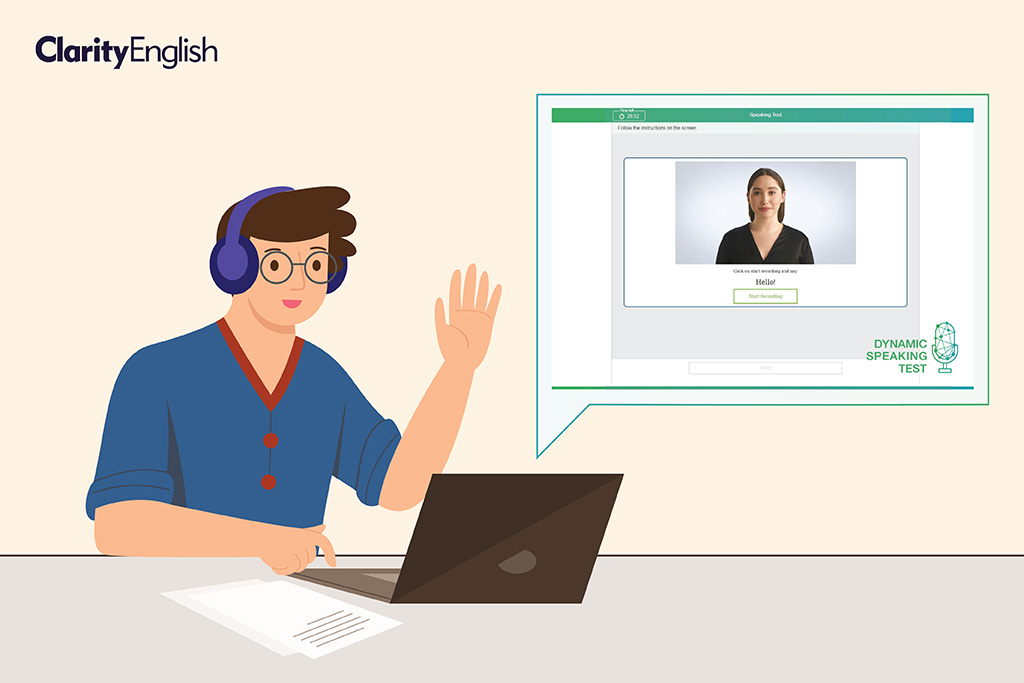
Let me take you back to the late ‘80s when I was a young teacher – just 25 years old – at the British Council in Penang, Malaysia. At the start of every term, we had an intake of new students, and each one had to complete a one-on-one speaking test for placement. It’s easy to see why this tedious job was given to the most junior teacher (me). Nobody else wanted to do it.
It’s also easy to see the problems this system caused. Reflecting on it now, I can identify five distinct headaches that will be familiar to any teacher who has faced a similar task.
The five headaches of the manual speaking test
- It was incredibly time-consuming. You could get through four, maybe five, students in an hour. With a large intake, the hours stacked up.
- It was expensive. While the test itself was free for the student, the cost of teacher and admin time was significant (or at least not insignificant) for the language centre.
- The grading criteria were non-existent. What was I actually measuring? There were no standardised questions. There was no explicit reference to fluency, accuracy, grammar or vocab. The test was basically a chat – a placement based on one teacher’s general impression.
- There were no benchmarks. Was a student’s performance measured against the CEFR? The IELTS scale? Or just my subjective notion of the level required for ‘Lower Intermediate Class 1, 2, or 3’ (as defined by the Cambridge English Course)? It was informed guesswork disguised as assessment.
- The human bias factor was unavoidable. What happens if a student comes in and you immediately like them? You want them in your class. It’s impossible to rule out the possibility of subconsciously, or even consciously, adjusting their grade.
For years, this was just an unavoidable, accepted reality of the system. But what if we could use a different tool?
What if an AI conducted the test?
Let’s turn to an alternative approach: an AI-powered speaking test. The immediate reaction might be scepticism, but major testing bodies have already paved the way. Cambridge Assessment (Linguaskill) and Pearson (PTE) use AI for this exact purpose. The market – that is, teachers and institutions – is increasingly accepting that it works, provided it is a test that draws firstly on the expertise of human testing specialists to devise a set of tasks, and only then turns to the strengths of AI in being able to measure the test takers’ performance.
Extensive research, including Clarity’s own calibration testing, has shown that for placement tests, a well-designed AI can perform as reliably as human markers. So, given that, would it solve the five headaches I identified in Penang?
Let’s look at the issues one by one.
- Time-consuming? SOLVED.
You can have 50 or 100 students take a computer-based test simultaneously, either in a lab or at home. The scores are recorded instantly. A task that once took 12 hours of a teacher’s life can now be completed in about 30 minutes.
- Expensive? MANAGEABLE.
Yes, an AI test has a cost. But so does a teacher’s time. The efficiency gains mean that a well-priced test can represent a net saving for the institution. (And don’t forget that it relieves teachers and admin staff of an onerous task.)
- No criteria? SOLVED.
This is where AI truly scores. A well-designed test uses standardised or parallel items, ensuring fairness. More importantly, the AI measures performance against criteria generated from millions of data points, assessing accuracy, fluency, grammar, vocabulary and task achievement with a level of detail no human brain can match. It’s objective, reliable, and valid.
- No benchmarks? SOLVED.
Modern AI tests, like the Dynamic Speaking Test (DST), are benchmarked against the CEFR. If classes are also CEFR-referenced (or indeed cross-referenced from another scale), sorting students into the correct level becomes a simple, data-driven task.
- Human Bias? SOLVED.
This is the easiest win of all. The AI is completely impartial. It doesn’t register what a student looks like, their personality, race, or religion. There is no conscious or unconscious bias to affect the result.
Freeing teachers for what truly matters
When you look at the evidence, the conclusion for a task like student placement is clear: AI does a better, more consistent, and fairer job than an overworked human. It provides detailed, actionable feedback for both the teacher and the student – and often there’s a bonus in the form of a certificate that gives learners a tangible record of their ability.
But this isn’t a story about technology replacing teachers; this is about technology empowering teachers. The AI test is simply a tool that an educator can choose to deploy for a specific task. By handing over the unbearable tedium of placement testing to a tool that does it better, we free up our most valuable resource – our time – to do what only a human can: teach, inspire, and connect with our students.
